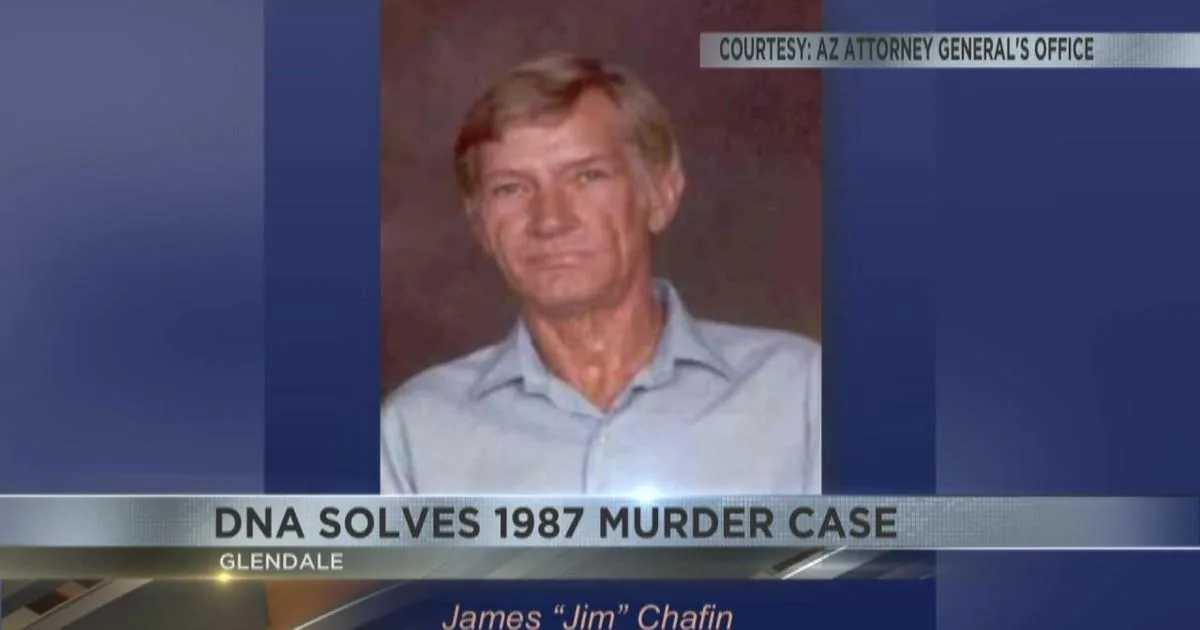
PHOENIX, AZ — DNA evidence has identified a suspect in the 1987 killing of a Navy veteran whose body was found in a Glendale cemetery, state and local investigators said Tuesday.
Officials with the Arizona Attorney General’s Office said modern forensic testing linked Gary Wayne Billups, a Wittmann man who was 68, to the death of 54-year-old Orison James “Jim” Chafin. Chafin was found dead on Aug. 8, 1987, in Resthaven Cemetery near 63rd and Northern avenues.
Billups died by suicide on June 24, 2026, just five days after he gave investigators a DNA sample, according to officials. Because he and two other people investigated in the case are now dead, authorities said no criminal charges will be filed.
How investigators reopened the Glendale cold case in 2025
The case had remained unsolved for more than 39 years before the Arizona Attorney General’s Office Cold Case Unit and Glendale police reopened it in 2025. Investigators began working with evidence from the original scene and trying to match it with modern DNA analysis.
Officials said Chafin’s body was found in the roadway inside the cemetery with his throat cut. Witnesses in 1987 reported seeing a midsize sedan leave the area during the early morning hours, shortly after the killing.
The long gap did not stop investigators from revisiting the evidence. Glendale police said the case shows why preserving physical evidence matters, especially when newer testing methods can produce answers years after a homicide first went unsolved.
Beer bottles and cigarette butts produced three male DNA profiles
Detectives recovered beer bottles and cigarette butts from the scene, and that evidence eventually yielded three male DNA profiles, according to the Attorney General’s Office. Those biological samples became central to the renewed investigation.
Investigators later learned that Chafin had spent the previous evening at Critters Lounge near 59th and Glendale avenues. Witnesses placed Billups and two other people with him there, giving detectives another piece of the timeline to examine.
That combination of witness statements and preserved evidence helped officials narrow the case. Even so, the homicide remained open for decades until forensic testing finally pointed investigators toward Billups.
Investigators located Billups in the West Valley in June 2026
Authorities said they found Billups on June 19, 2026, in the West Valley. He denied knowing Chafin, but he still agreed to provide a DNA sample, officials said.
Five days later, on June 24, Billups took his own life. The laboratory results came back later, on Aug. 6, 2026, and confirmed that his DNA matched evidence collected from the cemetery scene.
That result gave investigators the identification they had been seeking since 1987. But because Billups died before any prosecution could move forward, the case could not proceed to court.
Attorney General Kris Mayes calls the case a reminder to never forget victims
Attorney General Kris Mayes said Chafin was a veteran who served his country and died alone in a cemetery. She said it had long seemed that the person responsible might never be named, but investigators could now say who was involved in the killing.
Mayes also said no victim in Arizona should be forgotten, no matter how much time passes before answers arrive. Her remarks came as investigators announced the identification and closure of the case.
Glendale police echoed that message, saying the case demonstrates the importance of preserving critical evidence. Officials said the renewed testing gave the old homicide a resolution, even though it did not produce a criminal prosecution.
Family members still survive Chafin decades after his death
Chafin’s body was discovered more than 39 years ago, but officials said the identification still matters to the people who knew him. He is survived by a niece and nephew.
The case also underscores how a homicide can remain dormant for years before technology catches up to evidence gathered at the scene. In this instance, the preserved bottles and cigarette butts were still usable enough to help identify a suspect decades later.
With Billups deceased and the other two people connected to the investigation also dead, state and local officials said the investigation is closed. For Chafin’s family, the answer arrived late, but investigators said it was still important to finally name the person tied to the killing.