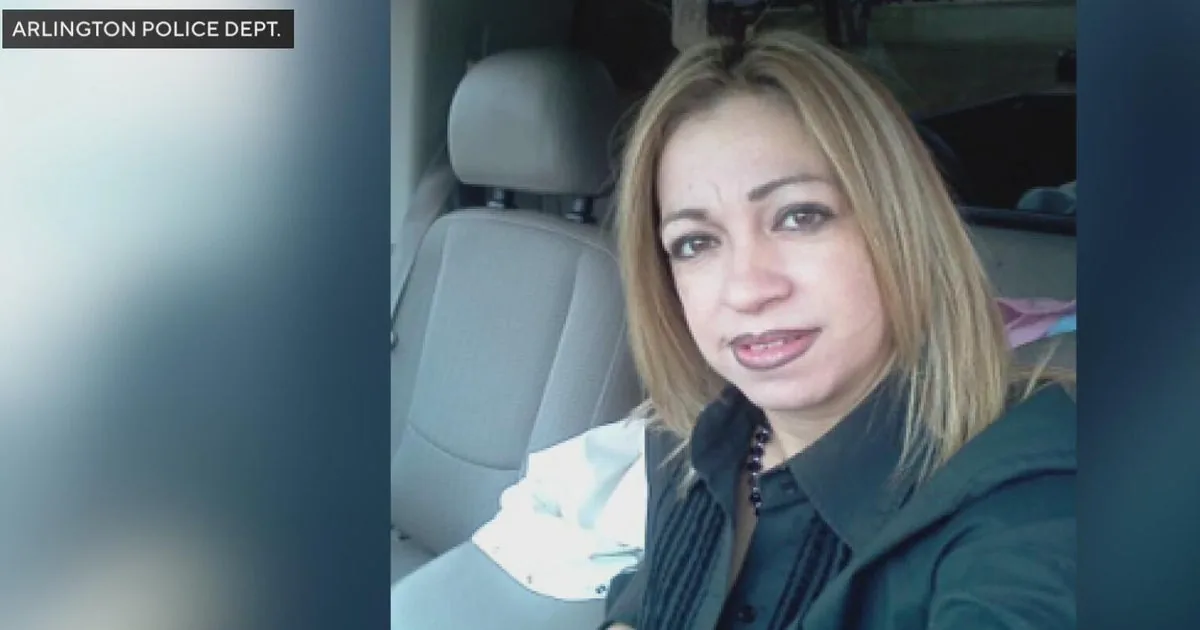
ARLINGTON, TX — Arlington police say a 14-year search for answers in one of the city’s most violent homicides has ended with an arrest. Detectives charged 42-year-old Mayra Velasquez with capital murder in the 2012 killing of 32-year-old Irasema Chavez, who was found dead in her apartment after being stabbed nearly 100 times.
Police said new forensic work, including investigative genetic genealogy and DNA recovered from discarded trash, tied Velasquez to the case. She was being held in the Tarrant County Jail as investigators continued to describe the motive as unclear.
Chavez was found dead after family members checked on her in 2012
Authorities said Chavez was discovered on Jan. 20, 2012, after relatives went to check on her at the Aspenwood Apartments on South Collins Street. Officers found numerous stab wounds and no signs of forced entry, which led investigators to believe she knew the person who attacked her.
At the time, police had few immediate leads. DNA from the crime scene did not match anyone in available databases, and witnesses could provide only limited information. The case remained open as detectives pursued a long list of leads that never produced a solid suspect.
A DNA profile and Parabon prediction gave detectives an early lead
In 2016, Arlington police sent a DNA profile developed from blood found at the scene to Parabon NanoLabs. The company used the profile to generate a prediction about the suspect’s physical appearance, giving investigators another tool to work with as the case stayed unsolved.
That early effort did not produce an arrest, but it helped preserve the forensic trail for later review. Police said the cold-case unit kept working the case over the years even as the investigation stalled and the original evidence failed to identify a suspect.
FBI genetic genealogy work renewed the investigation in 2024
In November 2024, Arlington homicide detectives contacted the FBI Dallas Field Office to explore investigative genetic genealogy, or IGG. The FBI agreed to help through its IGG program, which uses family-tree style analysis to narrow down possible suspects from DNA evidence.
Police said that work produced a significant lead in April 2026. Detectives used that break to develop additional evidence, though they did not publicly describe exactly what that evidence was. It was enough for investigators to seek and obtain a warrant for Velasquez’s arrest.
Trash DNA matched blood found in the victim’s bedroom
After the IGG lead, detectives collected a DNA sample from trash discarded by Velasquez in May 2026. The sample was sent to a crime lab for additional testing and compared with blood recovered from the scene.
Police said the results matched a blood droplet found on the bedroom television stand in Chavez’s apartment. Investigators said it is common in stabbing attacks for an attacker to accidentally cut themselves, which they believe is how Velasquez’s blood ended up inside the home.
Police say Velasquez was once close to Chavez and lived nearby
In a news release, Arlington police said Velasquez was “at one time a close friend” of Chavez. Detectives also said she lived only a few miles from the apartment where Chavez was killed, a detail that may have mattered as the case was pieced together over many years.
The arrest marked a major development in a case that had long frustrated investigators and shaken the neighborhood. Police have not said what prompted the stabbing, and they continued to describe the motive as unknown after laying out the timeline of the investigation at a Wednesday press conference.
The arrest surprised people who knew Velasquez
CBS News Texas reporter Briseida Holguin reported that Velasquez previously worked as a realtor and more recently as a sales representative for a local limo company. People who knew her said they were shocked and surprised to learn of the arrest.
The case also reflects a broader pattern in North Texas, where investigators have increasingly used genetic genealogy in older cases. CBS News Texas has recently reported on that technique being used in two decades-old kidnapping investigations as part of its “The Long Hunt” series.