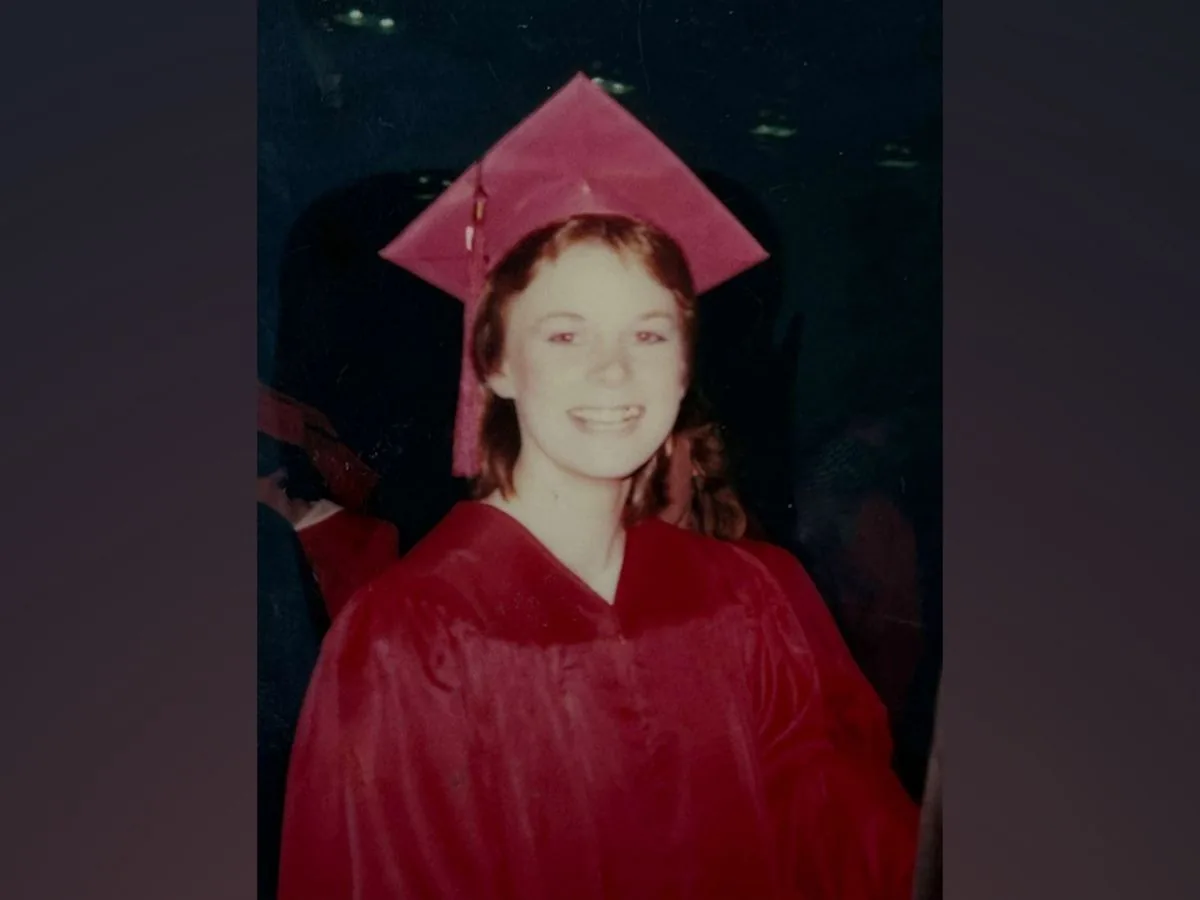
SALEM, MA — Claire Gravel’s family returned to her grave on a sunny Saturday in July for the first time since the woman who killed their daughter had been convicted and sentenced. For nearly four decades, the 20-year-old Salem State College sophomore’s death remained unsolved, leaving relatives with grief and no clear answers.
That changed after investigators linked DNA from the tank top Claire was wearing when she was strangled in 1986 to a man who was later convicted in an unrelated violent attack. The case ended this year with a guilty verdict, a life sentence without parole, and a measure of relief for a family that had waited years for accountability.
Claire Gravel was last seen leaving a Salem bar before she disappeared
Claire was studying political science and hoped to become a lawyer and raise a family of her own. On June 30, 1986, she did not report for her job at the National Braille Press. Her brothers and roommate reported her missing, and police soon began searching for clues about where she had gone.
Investigators later determined that Claire had been seen at Major MagLeashe’s, a local bar, in the early hours of June 29. A bouncer told police that a man who appeared out of place was talking with her that night. Officers also watched her funeral in case someone connected to the killing might reveal himself.
Investigators spent years chasing leads and comparing the case to other killings
The investigation stretched over decades, with detectives pursuing hundreds of leads and keeping a close eye on a smaller number that seemed most promising. Claire’s family, meanwhile, lived with uncertainty and no final explanation for what happened to her.
At one point, police examined whether the killing could be tied to a series of murders of young women in New Bedford, Massachusetts. Those nine cases were never connected to Claire’s death, and they remain unsolved. The long search shows how difficult it was to solve a case with limited forensic tools in the years before modern DNA work became routine.
Touch DNA testing on Claire’s tank top produced a male profile
In 2004, Detective Elaine Gill submitted Claire’s tank top for touch DNA testing as forensic science improved. Gill had been one of the first troopers on the scene in 1986, when she was 24 years old and only a few years older than Claire.
Nearly three years later, the testing produced a male DNA profile from the shirt. Detectives entered the profile into CODIS, the national DNA database, but there was no match at the time. The result gave investigators a new lead, but not yet a name.
A separate home invasion case finally pointed police to John Carey
The break came after John Carey was convicted in 2007 in Hamilton, Massachusetts, of home invasion and attempted murder in an attack on Rosemary Diskin. During that assault, Diskin’s 12-year-old son heard the struggle, came downstairs, and was told by his mother to get a knife and stab Carey.
After Carey’s conviction, his DNA was entered into CODIS. That profile matched the DNA found on Claire’s tank top. Detectives later learned that Carey had attended Salem State before Claire, in the late 1970s. Family and friends said they never knew of any connection between him and Claire.
Carey was convicted and sentenced to life without parole
Police charged Carey with Claire’s murder in 2022. He pleaded not guilty and went to trial in March of this year. After a trial that lasted nearly three weeks, jurors found him guilty.
A judge then sentenced Carey to life in prison without the possibility of parole. Carey is appealing the conviction. For the Gravel family, the outcome brought a long-delayed conclusion to a case that had defined much of their lives since 1986.
The verdict brought grief, relief and memories of Claire and her mother
Claire’s father, Bob Gravel Sr., attended the trial and still keeps a photograph of his daughter in his wallet. Her siblings said the family has never fully recovered from the loss, and that their mother changed after Claire died.
Denise Foley said both parents endured what she described as the worst thing a parent can face, followed by the pain of watching the other parent live through it too. Bob Gravel Jr. said his mother, Mary Gravel, lost the sparkle in her eye after Claire’s death. Mary Gravel died in 2015, after the DNA match but before Carey was charged. Claire and her mother are buried side by side.