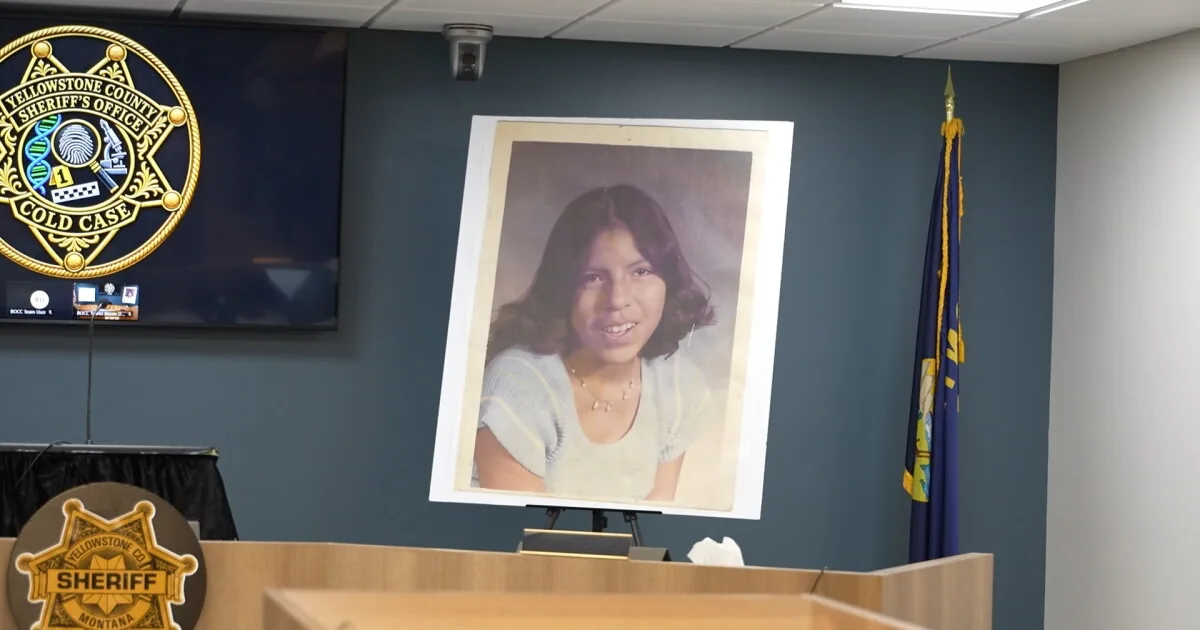
BILLINGS, MT — A 47-year-old murder investigation in Yellowstone County has finally been solved, according to investigators who say they identified the man responsible for killing 16-year-old Corina Lydia Contreraz in 1978.
Contreraz was killed on Dec. 22, 1978, and her body was found by a school bus driver at the intersection of Pryor Creek Road and Indian Creek Road east of Billings. An autopsy that day showed she had been sexually assaulted and stabbed 18 times.
No one was arrested at the time, and the case remained unsolved for decades until advances in forensic genealogy and DNA testing gave detectives a new path forward.
Investigators name Angelo James Stallsmith Sr. as the suspect
The Yellowstone County Sheriff’s Office says the killer was Angelo James Stallsmith Sr., who investigators believe was 29 years old at the time of the murder. Stallsmith later died in 1990 at Billings Deaconess Hospital, according to officials.
Investigators said there is no evidence that Contreraz and Stallsmith knew each other or had ever met. That detail suggests the attack was not tied to any known prior relationship between the teenager and the man police now believe killed her.
The sheriff’s office also said no murder weapon has been found. Even without the weapon, detectives say other evidence was enough to bring the case to a resolution after nearly five decades.
A 1982 fingerprint card became the key clue
One of the most important pieces of evidence in the case was a booking fingerprint card from 1982. Investigators said DNA still remained on the card, allowing modern testing to connect Stallsmith to the long-unsolved killing.
Officials described the old fingerprint card as the breakthrough that helped push the case over the finish line. The evidence survived long enough for techniques that were not available in 1978 to be applied years later.
Investigators said the combination of forensic genealogy and DNA testing finally cracked open a file that had sat unresolved for 47 years.
Detectives say modern tools changed what was possible
Authorities said the case likely would not have been solved without newer forensic methods. One investigator said that without modern technology, detectives would still be “spinning their wheels.”
The comments reflect how cold-case work has changed, especially when older evidence can be reexamined with tools that were not available when the crime first happened. In this case, investigators were able to make use of material collected long after the original murder.
For law enforcement, the resolution shows how dormant cases can still produce answers when physical evidence remains available and new testing methods emerge.
Corina Contreraz’s family heard the news with grief and relief
For Corina Contreraz’s cousin, Dotty Ramirez, the announcement brought both sorrow and a measure of peace. Ramirez traveled from Ohio and said her last memory of Corina was tied to a birthday celebration shortly before the killing.
Ramirez recalled learning what had happened after she returned home from shopping for a refrigerator with her mother. She said family members were acting strangely before a detective’s card confirmed the devastating news.
She described the moment as petrifying, and said the loss never faded over the years. According to Ramirez, birthdays, pictures and conversations with family kept the grief present for decades.
A family still carrying the loss after nearly five decades
Ramirez said the pain of Corina’s death remained intense because the family never got the chance to let it go. She said what hurt most was that nobody was there to help the teenager.
Even with the case now solved, the family cannot recover the years that were lost. Still, Ramirez said finally learning the truth has brought a sense of relief and gratitude.
Her reaction captured the emotional weight of a case that stretched across generations, with relatives waiting nearly half a century for the identity of the killer. The breakthrough does not erase the violence, but it does provide an answer that had long been missing.